About this blog...

Here you will find information, musings, and pictures about life, the natural world and writing.

Thursday, September 22, 2011

Here's a blog I did for Poisoned Pen Press. I'm hard at work on the next zoo mystery plus travel plus house guests, so this will have to do for now!

Day-Tripping with Crime Fighters


Monday, August 29, 2011

Try this at home: Enrich the Dog

I've been reading The Animal Keeper Forum lately, the newsletter of the American Association of Zoo Keepers. It's chock full of "enrichment" ideas--ways to stimulate, entertain, and challenge animals that might otherwise be bored into pacing, chewing on the fence, or harassing their companions. Instead, the keepers rack their brains to come up with puzzle feeders, toys, and a variety of experiences and sensations. They do this not just because they want the best quality of life for the animals, but also because a formal enrichment program is a requirement for Association of Zoos & Aquariums' accreditation.

Mind you, this has to be done is such a way as to not scare the bejabbers out of the critter, not give them the opportunity to damage themselves (think of a two-year-old and a nice length of rope), and not put the keeper or other animals at risk. The ideas are wonderfully creative.

Meanwhile, Murphy nudges my thigh and recommends another walk. How to apply the same creativity to my own dog? We provided lots of toys, puzzle feeders, and walks when Murphy was a puppy because it was entirely clear that he would destroy property relentlessly until and unless we did. But he's grown up now and we've slacked off. Time to think about this again.

Keepers work with scent, object, audio, food, and training categories of enrichment.

I tried scent first by digging out an old bottle of Wrappings perfume, by Clinique, and giving a few squirts to objects in the backyard. Murphy noticed that the yard now smelled like a bordello, but, frankly, he didn't give a damn. Bits of liver treats scattered on the lawn were a different matter. That's enriching as all get out.
 Got one!

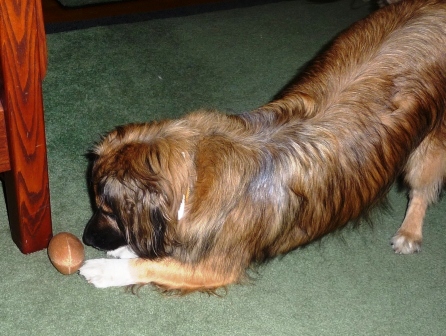
Next up: objects. I've neglected the rule for toys: rotate them. The eviscerated hedgehog, the shredded tug-a-war toy, the half-gnawed Nyla bones--yawn. I took them all away and dug out a weird fuzzy egg-thing with a squeaker in it. That is Big Fun. I'll give him one of his toys each day and take one away so they stay fresh.

Oooh! I will destroy you!

Audio: That was a stumper. Then I remembered Birdscapes, a big pop-up book by Miyoko Chu with the Cornell Lab of Ornithology. (I love pop-up books.) It opens to a landscape with bird and environmental sounds. I tried the Eastern Deciduous Forest, frogs and a ruffed grouse. Murphy was interested and a little scared, but the fuzzy brown egg was more fun. We have music in the house regularly, which doesn't interest him, but people use the sidewalk out front and sometimes have the effrontery to converse, which requires barking. Enough with the audio enrichment!

What the??

Food: See Scent, above. Liver treats says it all. No, we go farther. An adult dog needs to be fed only once a day, but we feed three times. He's a dog who appreciates a little garnish, not much, just--please--make an effort! A light grating of a nice Parmesan, a swirl of chicken gravy, a dribble of bacon grease. I am guilt-free on that subject. And, of course, there are puzzle feeders. I pull one of these out if we're going to be gone most of the day and either put his breakfast in it or a smear of peanut butter.

Training: We haven't done Circus Dog much lately. I've got this book to write! But it's only 15 minutes after dinner, so that excuse is lame. Murphy loves Circus Dog. Focused attention plus liver treats. What more could a dog ask? We have guests coming, so the show will be on. Sit, lie down, speak, shake hands, up on the stool, down from the stool, jump through the hoop. We working on fetch the brown chew toy versus fetch the white chew toy, but it's not in  place yet. Murphy leaves show biz to chew the chew toy.

House guests ought to be on the enrichment list, no? New faces, new petters. And his walks, once or twice a day, to check out the neighborhood and chase the ball at the park. I try to take a different route now and then. Sleep-overs with his friend Sally the cattle dog when we're out of town.

The Enriched Dog


What else can dog people do to keep their canine mentally alert and interested in life? Add a suggestion and I'll see what Murphy thinks of it.

Tuesday, August 23, 2011

Spoilerville


I've been hammering away at Threatened & Endangered, so don't expect much of a blog for awhile. That would be #3 in my zoo-dunnit series and it is action-packed. Now to get all that drama in the right order...

But here is a tidbit, a site called Spoilerville. It's for people to discuss books they've already read. So don't go snooping around there if you haven't read whatever book, because you will find spoilers in the discussion. Sounds like fun to me.

Here's the links to my books:
Night Kill
Did Not Survive


Murphy's ready for Spoilerville.

Sunday, August 7, 2011

Cow Whisperer

I freely confess that I don't know much about cows, at least not first hand. I can tell a Holstein from an Angus, but I've never had any hands-on experience. So perhaps some reader can educate me about their psychology.

We were traveling in Central Oregon in early July and got word that elk could be sighted at sun-down on the road to the Painted Hills. That turned out to be true, but too dark for photos. We saw bulls with antlers and calves frisking in the dusk--lovely.

But about the cows. On the way, before we found the elk, I pulled over at a pasture full of cows, I forget why. Son Jesse hopped out of the car and stood at the fence and stared at the cows. The closest ones stared right back. Then they walked toward him.

Notice the cows scattered all over the field.

He kept standing there and cows kept coming. Every single cow in that field bunched up watching him.

The cows came only just so close and if a cow got shoved closer, he or she struggled to get back behind that invisible line. I got Jesse to back up a few steps and the cows all took a few steps forward.

Now Jesse is a charismatic guy, no question. But I suspect this has to do with how cows are wired. They've got hooves, so they obey the "run if it's scary" rule, but if "it" isn't scary, does the rule become "walk up just so close and check it out?

Is this typical? If you have cow-sense or cattle wisdom, enlighten me!

Tuesday, July 12, 2011

Ivory and Rhino Horn: an Oregon (!?) Perspective

I live a long way from Africa, in the far western city of Portland, Oregon. A lifetime of interest in conservation and 12 years as a zoo keeper have kept me interested in African and Asian wildlife. I haven't made it to the great game parks of India and Nepal yet, but I visited Kenya this last March.

The myth of Africa is that it is still what the American West once was--open, unfenced, full of wild beasts roaming free. That visit in March showed me how outdated the myth is. Like the plains and mountains of eastern Oregon, northern Kenya is cattle ranches, farms, and towns. Elephants and lions roam there, elk and cougars in Oregon. The elephants and elk are fenced in or out and cursed for damaging farms. Lions and cougars are killed to protect domestic stock.

I don't want to exaggerate the commonality, but I've been finding other comparisons with Oregon.

It's conventional wisdom that Chinese money is driving wildlife poaching in southeast Asia and Africa. Kenyans told me that Chinese truck drivers keep suitcases of money in their cabs for purchasing wildlife products, and this is fueling illegal killing of elephants and rhinos.

This poaching is serious business. Much of it is now run by organized crime gangs with sophisticated weapons, night goggles, and money to buy political protection. Rhino poaching is at a 15 year high and elephant poaching continues unabated because there is a lot of money to be made.
White rhino in Kenya with her sleeping calf.

My reaction to the slaughter is anger and frustration, especially toward end consumers, the people who buy ivory objects to ornament themselves and their homes and who pay for useless rhino horn "medicines". I've remembered or discovered Oregon connections that require me to take a breath, dial back the blame, and try to understand.

People have admired ornamental objects made of ivory for millennia. My Portland grandmother collected ivory. It was legal. She bought pretty little carvings on trips to Thailand and loved them. I remember her crying when some were broken. Yesterday I saw an ad in the Oregonian for an auction that included carved ivory among its offerings.

I took the picture below in a Las Vegas casino Christmas before last.
It's two large elephant tusks intricately carved, with a model ship behind them made of bits of ivory.

The auction item and the Las Vegas offerings are almost certainly older pieces that entered the country before we outlawed their importation and their sale is legal.

So... some people in the U.S. find ivory objects attractive and are willing to pay (plenty) for them. If our government did not enforce international conservation laws, we'd have our own open market for new ivory. But we enforce those laws in part because we have enough people who see exterminating elephants for their tusks as repellent. We'd rather think of elephants alive, roaming those mythical wild spaces or at least the limited habitat we've left them.

As for rhino poaching, the goal is their horns and most of the market is for traditional Asian medicine. A week ago I visited a traditional Chinese pharmacy here in Oregon, in the remote town of John Day. Kam Wah Chung opened as a Chinese social center, labor center, general store, and clinic in 1871, serving Chinese men drawn out of starving Guangdong province by western gold strikes. The building is now a museum, "frozen in time" from the year it shut down, 1948. Click HERE to read its fascinating story.
What captured my attention was that herbalist Ing Hay provided medical care renowned throughout eastern Oregon and the adjoining states. In this intensely racist era, Doc Hay served both white and Chinese patients. Eventually blind, he diagnosed by "pulseology", reading four pulses on the wrists of patients. His treatments were herbal brews, usually described as foul tasting, and he stocked thousands of herbs and other medicinal materials that he ordered from China. Trade with China was far easier and more rapid in that period than I ever realized.
This is the barred pharmacy portion of the Kam Wah Chung building. Note the bear paw and deer leg in the middle, the many boxes of medicines behind.

Consider Ing Hay's competition. My great-uncle graduated from the University of Oregon medical school and worked in Baker City, less than 100 miles from John Day, in the 1890s and early 1900s. I have his black leather medical bag. He could set bones, deliver babies, and sew up wounds, but he had few weapons to combat bacterial infections or pneumonia or many other lethal diseases, such as the infection that killed him at age 49.
Dr. William Parker and Comeaux, about 1896.

Sulfa drugs were developed starting in 1939. Penicillin was discovered in 1928, but was not readily available until World War II, when we raced to develop and produce this new miracle drug to save injured soldiers.

No wonder "the Chinaman" did not lack for customers--Ing Hay had treatments for their ails, and his patients learned that no one else did. He died at about age 83, well respected and one of the few Chinese left in John Day.

Practices change, people adapt, old convictions fade. I have my great-uncle's watch fob with an elk's tooth, from his membership in an Elks Lodge. We no longer allow elk to be killed for their two canine teeth. He used the most modern treatments available, but would not recognize much of medicine today. Cultures are not static, especially modern ones.

Why were Americans so willing to abandon herbal and folk treatments? Why do the Chinese and other Asians maintain those traditions? Whatever the reasons, people trust traditional Chinese medicine today just as Ing Hay and his patients did in Oregon a century ago.

The question that matters to me: How to put an end to the slaughter of elephants and rhinos for knick-knacks and outmoded medicines? One path is law enforcement. Another is cultural change--curbing the demand. WildAid and Rhino Conservation address the market for wildlife products in China and other countries through public service ads. World Wildlife Fund works with practitioners of traditional Chinese medicine in the United States to reduce Chinese-American demand.

Oregon hasn't seen free roaming rhinos for millions of years or elephants for thousands (yes, once upon a time both lived here.) To have a species vanish due to natural processes saddens me--I want them all, now. But that's a naturalist's sentimentality. It's quite a different matter to watch our own species exterminating the wonderful biota we inherited. That's not sentimentality, it's moral outrage. Outrage is fine as a motivating force, but it's not necessarily strategic.

Energetic people of good will are doing their best to let elephants and rhinos continue to live out their lives as they always have. I will do my best to give them a hand and I wish you would, too--Oregonians and everyone else.

Friday, July 8, 2011

Cakes, 911, and Night Kill

I did my author thing at a book club last night. I'd never met with a book club before. A group of Vancouver, Washington, women had read Night Kill and asked if I would join them.

What a fun bunch of smart women! We had a great conversation about zoos and grief and nature and a dozen other topics. Thanks, Chris and Kelly and Lisa and the rest of you!

I was amazed that one of them had made me a cake--with a lion and a book! Now I know I've hit the big time. Check out Drake's Cakes on Facebook.

The invitation came as a result of a drive-along I did with a Clark County Deputy Sheriff. Turns out, some of the book club members are 911 operators (and married to deputies). I said, "I bet you have great stories." The reply? "Oh, yeah. You should come sit with us." I learned what DRT means--dead right there. (I do so love work jargon.) I also learned that 911 operators can locate you by your cell phone call only on television. If you get lost, don't call them.

I'll be scheduling that 911 experience soon.